
7 Differences Between Adjectives and Adverbs
Language is filled with words that modify and describe, but not all of them serve the same function. The difference between adjectives and adverbs is one of the most essential concepts in grammar. Both are parts of speech that modify or give more details about other words, yet they work differently depending on what they describe.
Understanding whether a word is an adjective or an adverb can help you write more precisely, communicate ideas clearly, and avoid common grammatical mistakes. Below are the seven key differences between adjectives and adverbs, with examples to help you learn the difference and use them correctly in your sentences.
Written by
- Redaction Team
- Professional Career, Professional Development
Table of Contents
1. Adjectives Modify Nouns and Pronouns
An adjective modifies a noun or pronoun, giving more information about it. Adjectives describe nouns and pronouns by answering questions such as what kind?, which one?, or how many?
For example:
The beautiful garden is full of flowers.
She wore a red dress.
In both cases, the adjectives modify nouns (garden and dress). An adjective phrase can also give more details about the nouns they modify, adding richness to the sentence.
Adjectives are used to modify nouns and pronouns directly, never verbs, which is one of the easiest ways to tell the difference between an adjective and an adverb.
2. Adverbs Modify Verbs, Adjectives, or Other Adverbs
The adverb is a part of speech that modifies verbs, adjectives, or even other adverbs. Adverbs describe verbs by telling how, when, where, or to what extent something happens.
For example:
He ran quickly.
She sang beautifully.
In these examples, the adverbs modify the verbs (ran, sang). Adverbs can also modify adjectives or other adverbs, such as:
The test was very difficult.
He worked quite efficiently.
Most adverbs end in -ly, which is often the best way to tell the difference between these two types of words, though not all adverbs follow this rule (e.g., well, fast).
3. Adjectives Follow Linking Verbs
Another difference between an adjective and an adverb lies in how they behave with linking verbs. When a sentence uses a linking verb (such as be, seem, appear, become, feel), an adjective follows it to describe the subject, not the action.
For example:
The soup tastes delicious.
He seems tired.
In both cases, the adjective follows the linking verb and gives more information about the noun or pronoun. Using an adverb here would be incorrect because adverbs modify verbs, not nouns or pronouns linked through a linking verb.
4. Adjectives and Adverbs Modify Different Parts of Speech
The difference between adjectives and adverbs becomes clearer when you look at what they modify.
Adjectives modify nouns and pronouns.
Adverbs modify verbs, adjectives, and other adverbs.
For example:
Adjective: She has a strong voice.
Adverb: She speaks strongly.
The part of speech that the word modifies determines whether it’s an adjective or adverb. If the word is modifying anything else—like a verb or adjective—it’s likely an adverb. If it’s modifying a noun phrase or a noun or pronoun, it’s an adjective.
5. You Can Turn Many Adjectives into Adverbs
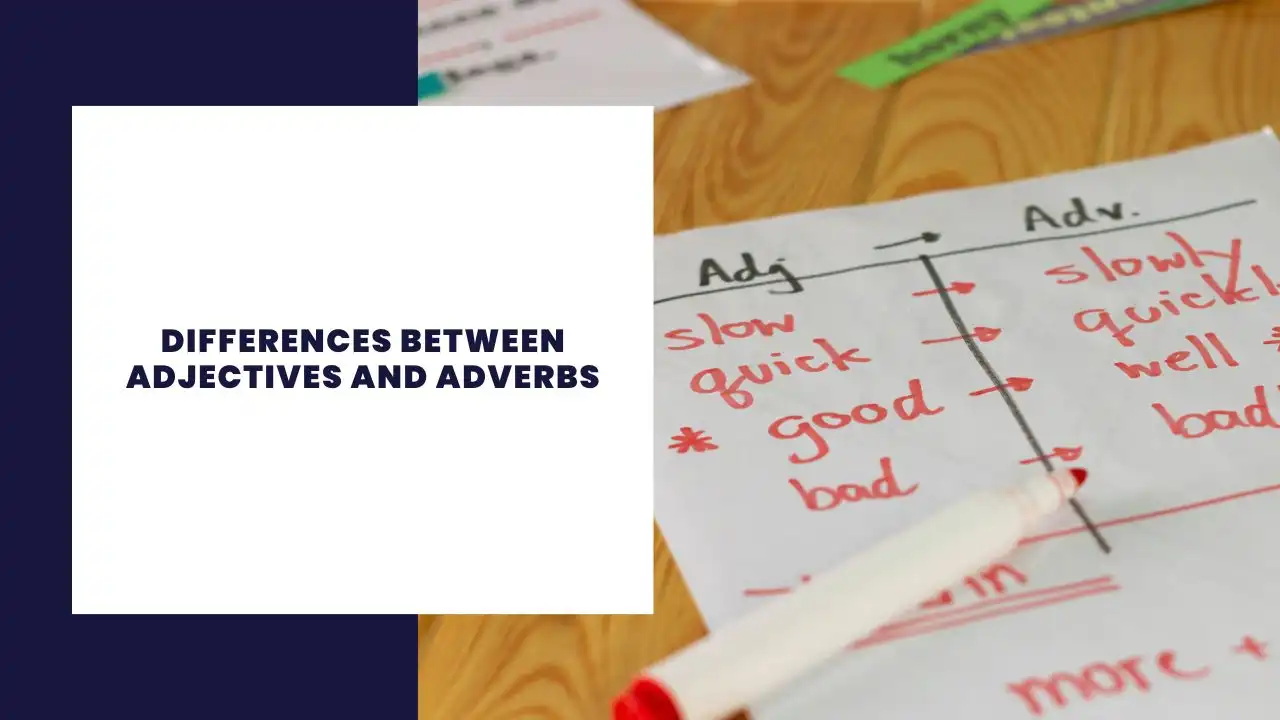
Many adjectives can be turned into adverbs by adding -ly at the end. This is one of the most common ways to form adverbs from adjectives.
For example:
Quick → Quickly
Happy → Happily
Careful → Carefully
This rule helps identify whether a word is an adjective or an adverb. However, not every adverb ends in -ly, and not every word ending in -ly is an adverb. For instance, friendly is an adjective, not an adverb.
These words can be used differently depending on the sentence, so pay attention to what word they modify to tell if it’s an adjective or an adverb.
6. Adverbs and Adjectives Change Sentence Meaning Differently
Many adjectives can be turned into adverbs by adding -ly at the end. This is one of the most common ways to form adverbs from adjectives.
For example:
Quick → Quickly
Happy → Happily
Careful → Carefully
This rule helps identify whether a word is an adjective or an adverb. However, not every adverb ends in -ly, and not every word ending in -ly is an adverb. For instance, friendly is an adjective, not an adverb.
These words can be used differently depending on the sentence, so pay attention to what word they modify to tell if it’s an adjective or an adverb.
7. Adverb Clauses and Adjective Clauses Work Differently
Another key difference between an adverb clause and an adjective clause is what they modify and how they function within a sentence.
An adjective clause (or adjective phrase) describes a noun or pronoun and usually begins with words like who, which, or that.
The book that you gave me was amazing.
An adverb clause, on the other hand, modifies the verb and begins with subordinating conjunctions like because, although, when, or if.
She left because she was tired.
Adverbs are used to explain why, when, or how something happens, while adjectives describe nouns and pronouns. Understanding the difference between these two clauses helps you use an adverb clause or adjective clause correctly.
FAQs About Topic
The difference between adjectives and adverbs lies in what they modify. Adjectives modify nouns and pronouns, while adverbs modify verbs, adjectives, or other adverbs.
Check what the word is modifying. If it modifies a noun or pronoun, it’s an adjective. If it modifies a verb, adjective, or another adverb, it’s an adverb.
No, not all adverbs end in -ly. Some adverbs like fast, hard, and well do not. However, adding -ly is a common way to form adverbs from adjectives.
Yes. When you use a linking verb such as be, seem, or feel, the word that follows is an adjective, not an adverb. For example: The soup smells good (not well).
Understanding adjectives and adverbs helps you write more accurately. It ensures you use modifying words correctly and avoid confusion in meaning, especially when adjectives give details about nouns and adverbs describe actions.
Conclusion
The difference between adjectives and adverbs is fundamental to mastering grammar. While both are used to modify and add description, they modify different parts of speech. Adjectives modify nouns and pronouns, while adverbs modify verbs, adjectives, and other adverbs.
Knowing when a word is an adjective or adverb—and how to change adjectives into adverbs—will help you write with precision and clarity. The way to tell the difference is always to ask: what word is being modified? That simple question will guide you to the right choice every time.
More about Professional Career