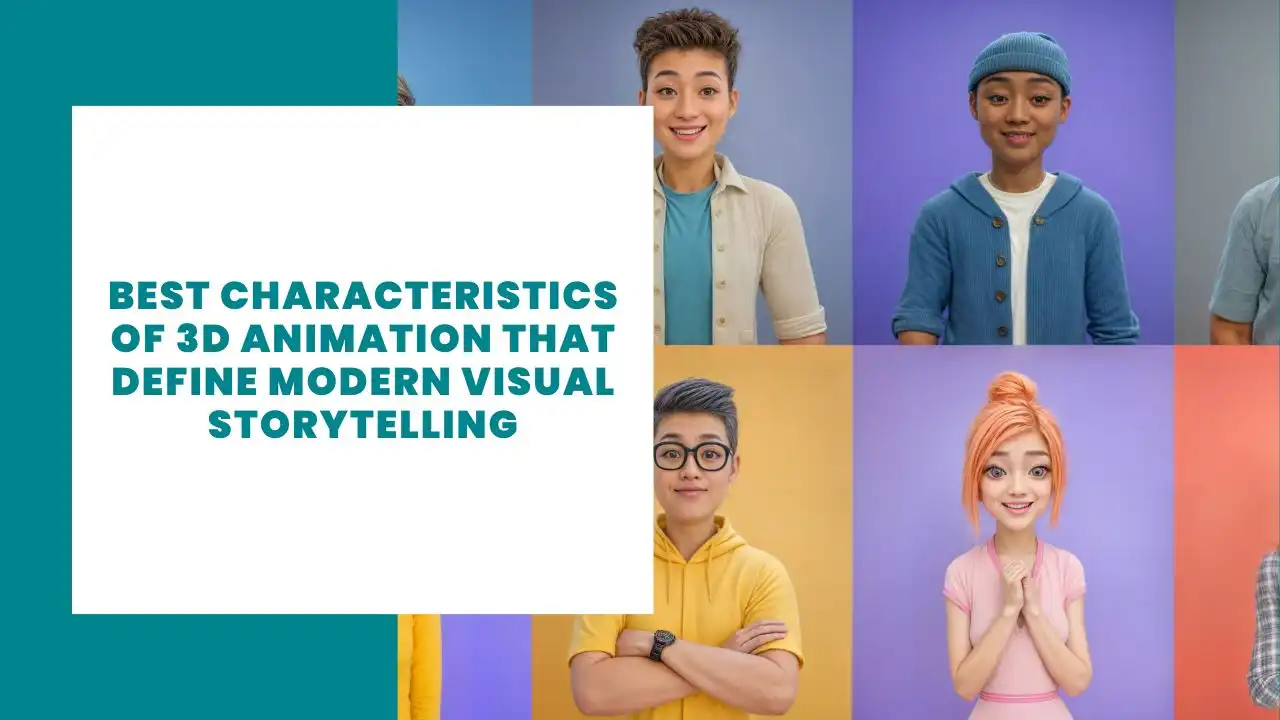
3D animation has become one of the most influential forms of digital animation across the entertainment industry, marketing, education, and product design. From animated film and 3D animated movies to short 3D videos used for advertising, this type of animation reshaped how stories are told and how products are presented. While traditional 2D animation and hand-drawn animation still hold artistic value, 3D animation brings depth, realism, and technical versatility that continues to evolve with 3D technology. Understanding what makes great 3D animation helps creators, studios, and audiences recognize quality, innovation, and effective visual communication.
Below are the seven best characteristics of 3D animation, based on the animation process, animation principles, and best practices used by animation studios worldwide.
1. Depth and Realism in 3D Space
One defining feature of 3D animation is its ability to create convincing depth within a true 3D space. Unlike 2D animation, which relies on flat planes, 3D animation is a technique that builds scenes using 3D objects that exist in virtual space. Every 3D model has height, width, and depth, allowing the camera to move naturally through a 3D scene.
This realism is why 3D animation in movies and animation for product visualization feels immersive. Lighting, textures, and shadows interact with 3D characters and environments in ways that closely resemble the physical world. When done well, high-quality 3D animation enhances believability and strengthens emotional impact, making animation will look natural and cinematic rather than artificial.
2. Strong Character Design and Character Animation
Compelling character animation is at the heart of great 3D animation. A skilled 3D animator begins by creating a 3D model of a character, then applies a rig—a digital skeleton that allows the animator to animate movement. Through keyframe animation and facial animation, characters can express emotion, personality, and intent.
What separates good 3D animation from great 3D animation is the attention to animation principles such as timing, weight, and anticipation. Whether working on fully 3D films or stylized 3D projects, animators must ensure that every movement feels purposeful. 3D animation brings characters to life in ways that make them relatable, believable, and memorable.
3. A Structured and Repeatable Animation Process
The 3D animation process follows a well-defined workflow that supports consistency and quality. The process of creating 3D typically begins with concept art and storyboarding, followed by creating a 3D model, texturing, rigging, and then animating. Each animation sequence is refined through lighting, rendering, and post-production.
Because this animation process is structured, animation studios can scale projects from short animation videos to full-length 3D animated movies. Using 3D animation software and specialized software, teams collaborate across departments to maintain quality of 3D while meeting deadlines. This repeatable pipeline makes 3D animation widely used in the animation industry and in commercial animation services.
4. Technical Power Through Advanced Software and Tools
Modern 3D animation relies on powerful 3D animation software and 3D animation tools. Software like industry-standard 3D software packages allows artists to create complex 3D objects, simulate physics, and control lighting with precision. These tools support motion animation, fluid animation, particle effects, and realistic rendering.
The use of 3D animation technology enables effects that would be impossible with traditional animation alone. Whether using 3D animation tools for an animated film or animation for product marketing, technology enhances efficiency, visual fidelity, and creative freedom. Creating 3D has become more accessible, but mastering the tools still requires deep knowledge and skills.
5. Visual Consistency and Scalable Style
Another hallmark of the best 3D animation is consistent animation style across characters, environments, and scenes. Whether the project aims for realism or stylized 3D, visual coherence ensures that every element belongs to the same world. This is especially important in animation in movies and large-scale 3D animation videos where multiple artists contribute to the same project.
3D animation offers flexibility in style that 2D animation and 3D animation each approach differently. Traditional 2D animation often emphasizes line and color, while 3D allows artists to experiment with textures, lighting, and materials. This scalability of style makes 3D animation suitable for everything from entertainment industry blockbusters to educational animation videos.
6. Adaptability Across Industries and Media
3D animation is used far beyond films. It plays a vital role in architecture, medicine, engineering, advertising, and animation for product demonstrations. 3D animation isn’t limited to storytelling; it is also a powerful tool for explaining complex ideas visually.
From 3D animation in movies to corporate animation video projects, the ability to animate in three-dimensional environments helps audiences understand form, function, and movement. Animation can help companies communicate ideas that would be difficult or expensive to show in real life. This adaptability is why 3D animation has become a cornerstone of the modern animation industry.
7. Evolution Built on a Rich History of Innovation
Understanding the history of 3D animation highlights why it is so influential today. Animation began with early animation techniques such as hand-drawn animation and stop-motion. As computers advanced, 3D animation started to emerge through 3D computer graphics and early experiments in computer animation.
Over time, animation and 3D merged into a dominant visual language. 3D animation started as a novelty but quickly matured into a professional discipline used by major animation studios. Today, animation is used in everything from blockbuster films to short 3D videos on social platforms. This evolution reflects how animation technology continues to push creative boundaries.
FAQs About 3D Animation
What is 3D animation and how does it differ from 2D animation?
3D animation is a type of animation created in three-dimensional space using 3D models and specialized software. Unlike 2D animation, which is flat, 3D allows depth, realistic lighting, and camera movement, making scenes appear more lifelike.
Is 3D animation better than traditional animation?
3D animation isn’t inherently better than traditional animation. Each type of animation serves different creative goals. While 3D animation offers realism and technical precision, traditional 2D animation and hand-drawn animation provide unique artistic expression and stylistic charm.
What does the 3D animation process involve?
The 3D animation process includes modeling, texturing, rigging, animating, lighting, and rendering. Animators create a 3D scene, apply motion through keyframe animation, and refine each animation sequence to achieve high-quality results.
What software is used for creating 3D animation?
Professionals use 3D animation software and other specialized software to model, rig, and animate characters and environments. These tools support creating 3D objects, facial animation, motion animation, and realistic rendering.
Why is 3D animation so widely used today?
3D animation is widely used because it is versatile, scalable, and visually powerful. It is applied in animated film, advertising, education, architecture, and animation for product visualization, making it essential across the entertainment industry and beyond.
Conclusion of 7 Best Characteristics of 3D Animation
The best 3D animation combines artistic vision with technical mastery. Its defining characteristics—depth in 3D space, expressive character animation, a structured animation process, advanced software, visual consistency, adaptability, and a legacy of innovation—set it apart from other forms of animation.
As 3D animation technology continues to evolve, the quality of 3D, the tools available, and the creative possibilities will only expand. Whether used for storytelling, education, or product communication, 3D animation offers a powerful way to create engaging, immersive, and visually compelling experiences in the modern digital world.