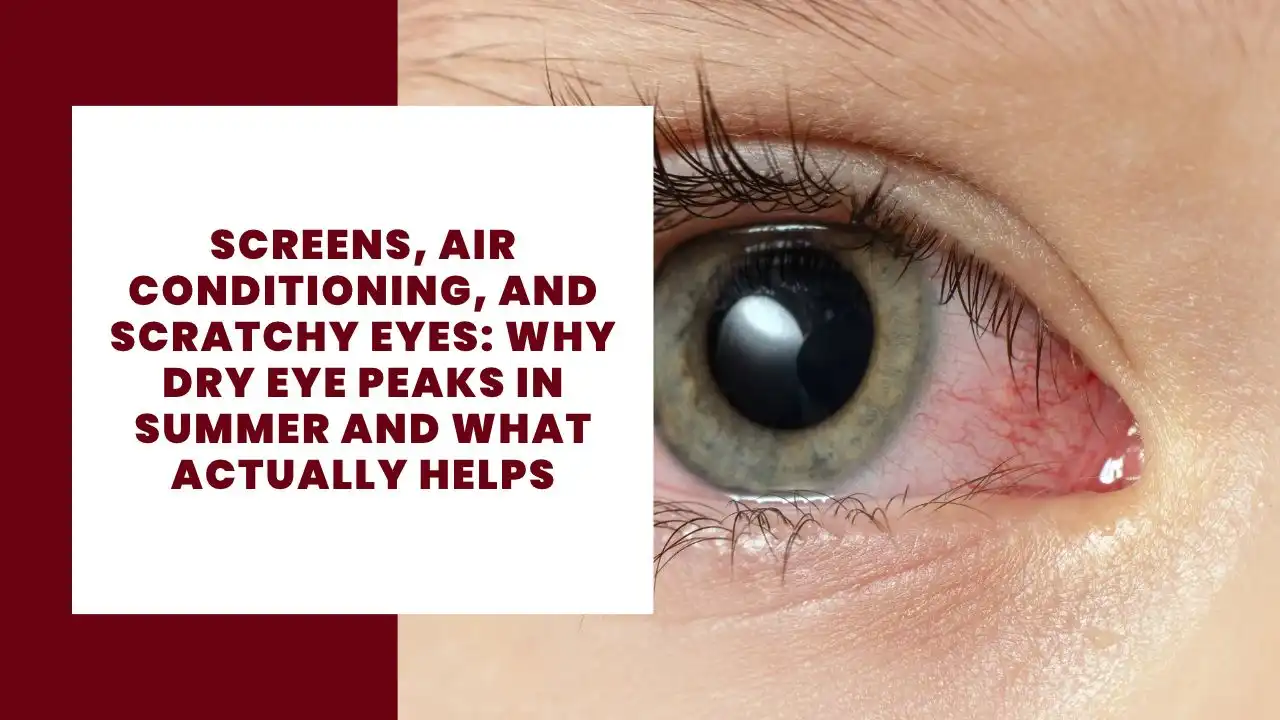
Most people assume dry, irritated eyes are a winter problem. Cold air outside, heaters inside, and the season practically begs for artificial tears. But ask anyone who spends July in a hot climate and they will tell you a different story. Summer is when gritty, burning, tired eyes tend to show up, and it is rarely a coincidence.
The culprit is a combination of habits and environment. Air conditioning runs constantly, pulling moisture out of indoor air. Ceiling fans and car vents blow directly across the face for hours at a time. Screen time climbs during the hottest part of the day, and every hour on a laptop or phone lowers your blink rate dramatically. Add chlorinated pools, road trips with the AC on full blast, and seasonal allergies, and you have a recipe for a tear film that simply cannot keep up.
What dry eye actually is
Dry eye is not just a lack of tears. It is a condition where the quality or quantity of your tear film breaks down. Your tears are a layered structure: an oily outer layer that slows evaporation, a watery middle layer, and a mucus layer that helps everything spread evenly. When the oil glands along your eyelids become blocked or sluggish, tears evaporate faster than your eyes can replace them. That is why so many people with dry eye describe watery eyes, which sounds like a contradiction. The eye senses dryness and floods itself with poor-quality reflex tears that do not fix the problem.
Common symptoms include a gritty or sandy feeling, burning, blurry vision that improves when you blink, tired eyes by mid-afternoon, and sensitivity to light. Contact lens wearers often notice their lenses become uncomfortable hours earlier than they used to.
Why the drops you grabbed at the pharmacy are not enough
Artificial tears have a place, and preservative-free versions can genuinely help mild cases. The trouble is that drops treat the symptom, not the cause. If your oil glands are blocked, no amount of watery drops will restore the protective layer that keeps moisture on the eye. According to the American Academy of Ophthalmology, dry eye is a chronic condition for many people, and managing it well usually means identifying which layer of the tear film is failing.
That distinction matters because modern dry eye care looks very different from a bottle of drops. An evaluation can measure how quickly your tears evaporate, image the oil glands in your eyelids, and check for inflammation on the surface of the eye. Treatment is then matched to the cause: warm compress routines and lid therapy for gland blockage, prescription anti-inflammatory drops when inflammation is driving the cycle, or in-office treatments for stubborn cases.
Simple habits that make summer easier on your eyes
A few practical changes go a long way. Redirect car vents toward your chest instead of your face. Follow the 20-20-20 rule during screen sessions: every 20 minutes, look at something 20 feet away for 20 seconds, and blink fully while you do it. Wear wraparound sunglasses outdoors, since wind and UV exposure both aggravate the ocular surface. Swim with goggles in chlorinated pools. And if you use a fan at night, aim it away from your pillow.
Hydration helps too. Your tear film is mostly water, and a body running low on fluids in the heat has less to spare for your eyes.
When it is time to see a professional
If your eyes feel dry, tired, or irritated more days than not, or you find yourself reaching for drops several times a day, it is worth having the underlying cause evaluated rather than guessing. Residents of central Texas can book an evaluation for dry eye treatment in Austin with the optometry team at Envision Eye Center, an independent practice in the Mueller district of East Austin that focuses on treating the cause of dry eye rather than masking symptoms.
Dry eye rarely goes away on its own once it becomes chronic, and untreated inflammation tends to build over time. The earlier the cause is identified, the simpler the fix usually is. Your eyes carry you through every workday, road trip, and pool afternoon of the season. They have earned better than a summer spent squinting.
Practice location for readers in the Austin area: