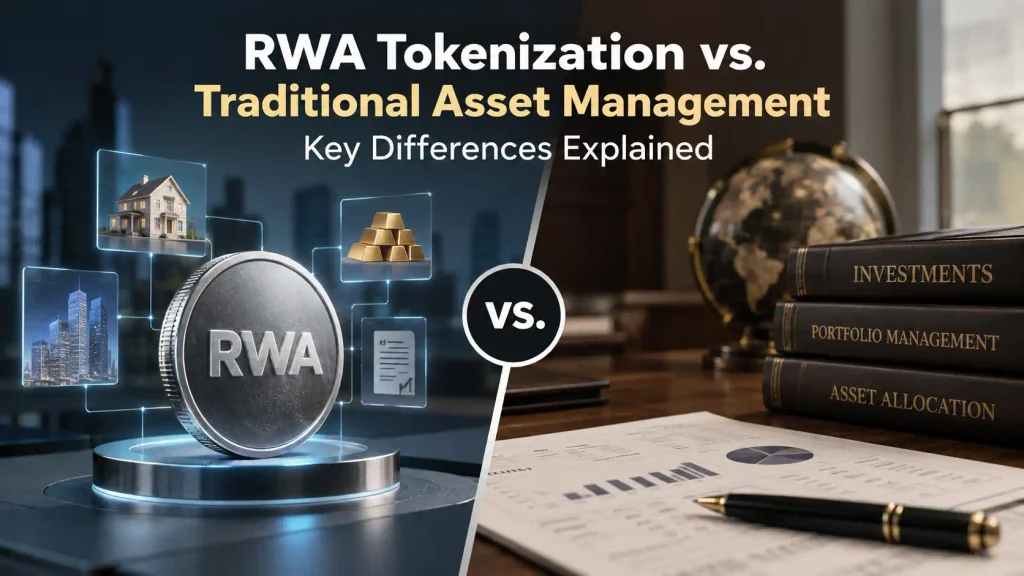
RWA tokenization uses blockchain-based tokens to represent ownership, claims, or economic exposure connected to real-world assets. Traditional asset management relies mainly on established fund structures, custodians, transfer agents, brokers, and centralized records. Tokenization is primarily an infrastructure and distribution model, not an investment strategy, so a conventional fund can be tokenized without changing its portfolio. Legal structures vary, making it important to check exactly what rights a token provides.
Key Takeaways
- Tokenization changes how ownership is recorded and how assets move, not necessarily what investors ultimately own.
- Traditional systems maintain records across intermediaries and databases, while tokenized structures can place some or all ownership or entitlement records on a blockchain.
- Potential benefits include programmable transfers, faster settlement, greater transparency, and integration with on-chain financial applications.
- For regulated tokenized funds and securities, asset managers, custodians, transfer agents, KYC requirements, and securities regulation may remain part of the structure.
- Tokenization does not automatically lower costs, increase liquidity, or improve investment returns. It also introduces smart-contract, custody, legal-structure, and blockchain infrastructure risks.
What Do RWA Tokenization and Traditional Asset Management Actually Mean?
Traditional asset management
In a conventional investment structure, investors may access assets through brokers, distributors, banks, funds, or other investment vehicles. Asset managers make portfolio decisions, while custodians safeguard assets and transfer agents or administrators maintain relevant investor records.
The supporting infrastructure varies by asset class. Public equities, bonds, money-market funds, private credit, real estate vehicles, and commodities do not all use identical trading, custody, clearing, or settlement arrangements. What they generally share is reliance on regulated institutions and established off-chain recordkeeping systems.
RWA tokenization
RWA tokenization uses distributed ledger technology to represent rights or economic interests linked to assets outside the blockchain. Structures can include securities whose ownership records incorporate blockchain, tokenized shares of conventional funds, digital-twin models linked to off-chain registers, and synthetic instruments that track an asset without transferring ownership of it.
That distinction matters because a tokenized product does not automatically give its holder direct ownership of the referenced asset. The rights depend on the legal and operational structure behind the token.
The broader RWA crypto sector also includes native tokens associated with protocols focused on real-world assets, which should not be confused with tokens that represent direct claims on specific off-chain assets. For example, users looking to trade RIOUSDT are trading a crypto asset connected to the Realio Network ecosystem rather than necessarily acquiring a tokenized claim on a particular real-world asset.
RWA Tokenization vs. Traditional Asset Management at a Glance
| Area | Traditional Asset Management | RWA Tokenization |
| Ownership records | Centralized registries and institutional databases | Fully or partly blockchain-based |
| Asset structure | Funds, securities, accounts | Tokens representing securities, fund shares, entitlements, or other claims |
| Transfers | Established broker, custodian, and market infrastructure | Blockchain transfers and smart contracts where permitted |
| Settlement | Conventional clearing and settlement processes | Potential for faster or atomic settlement |
| Availability | Usually tied to market or platform hours | Broader transfer windows may be possible |
| Fractionalization | Product-dependent | Often easier to implement technically |
| Compliance | KYC/AML and applicable securities rules | Similar rules may apply, sometimes enforced through wallet controls |
| Custody | Banks, brokers, custodians | Institutional custody, wallets, or hybrid arrangements |
| Transparency | Reporting and institutional records | Potentially near-real-time on-chain records |
| Additional risks | Operational and intermediary risks | Smart contracts, keys, bridges, networks, and legal structure |
Most differences therefore sit in the infrastructure rather than the investment thesis itself.
The Biggest Difference Is How Ownership Is Recorded and Transferred
Traditional finance often tracks ownership through interconnected records maintained by brokers, custodians, transfer agents, and securities depositories. Tokenization can move part or all of this recordkeeping onto blockchain infrastructure.
In an on-chain authoritative model, the blockchain forms part of the official ownership record. In a hybrid or digital-twin model, the token references or helps update an authoritative register maintained elsewhere.
A January 28, 2026 staff statement from the SEC’s Divisions of Corporation Finance, Investment Management, and Trading and Markets illustrates this distinction. It separates issuer-sponsored tokenized securities from third-party structures and further discusses custodial and synthetic models. The statement is explicitly a staff view, not Commission guidance, a rule, or a regulation, and it does not itself create new legal obligations.
Under some third-party structures, a holder may own an entitlement linked to securities held in custody. Under others, the token may only provide synthetic exposure and no rights against the issuer of the referenced security. The practical question is therefore not simply whether an asset is “on-chain,” but which record is legally authoritative and against whom the holder has a claim.
Smart contracts can then automate functions such as wallet eligibility, transfer restrictions, issuance, redemption, and certain distributions. They execute rules established by issuers, administrators, or other responsible parties rather than eliminating those roles.
Does Tokenization Make Trading and Settlement Faster?
Traditional transactions can involve separate execution, clearing, reconciliation, custody, and settlement processes. Tokenized infrastructure can compress some of these steps.
Atomic delivery-versus-payment links the asset and payment legs so that one settles only if the other does. This can reduce principal and settlement risk compared with unlinked transfers, but it does not remove every exposure. Liquidity risk, replacement-cost risk, operational failures, and other counterparty dependencies can remain.
DTCC’s Great Collateral Experiment demonstrated the operational potential in 2025. DTCC reported live on-chain collateral movements, automated rules, and settlement timelines compressed from hours to seconds. The demonstration is evidence of what the infrastructure can support, not a guarantee that every tokenized market will achieve the same result.
Limits also remain. Underlying markets may keep specific operating hours, redemptions can depend on issuers or administrators, and fiat rails may still constrain settlement. A token being transferable around the clock does not mean it has continuous market liquidity.
How Do Custody and Investor Control Differ?
Traditional investors typically hold assets through brokerage, bank, retirement, or fund accounts. Tokenized holdings may instead appear in institutional digital wallets, investor-controlled wallets, or permissioned blockchain accounts.
Tokenization should not be equated with unrestricted self-custody. Regulated securities can still require approved wallets, identity verification, transfer agents, and institutional custodians.
DTCC’s Tokenization Service shows how administrative control can remain in a blockchain-based system. DTC-issued tokens include functions for minting, burning, pausing, and clawbacks to support operational oversight and compliance. DTCC also states that tokenized positions remain extensions of DTC’s books and records.
These mechanisms can support recovery and compliance, but they also demonstrate that institutional tokenization can differ substantially from permissionless crypto self-custody.
Where Can Tokenization Improve Asset Management Efficiency?
The strongest potential benefits come from improving processes rather than automatically reducing investment costs. Shared ledgers may reduce reconciliation, programmable rules can automate parts of compliance, and faster asset movement can improve collateral management and operational visibility.
BlackRock’s BUIDL offers one practical example. In April 2026, OKX, BlackRock, and Standard Chartered announced a framework allowing eligible OKX clients to use BUIDL, BlackRock’s tokenized short-term Treasury fund, as trading collateral while Standard Chartered provides off-exchange custody.
That expands what a fund share can potentially do within digital-market infrastructure. It does not show that a tokenized fund will outperform a conventional fund or that tokenization itself increases returns.
What New Risks Does RWA Tokenization Introduce?
Legal and ownership risk. A token can represent direct ownership, an indirect security entitlement, a contractual claim, or synthetic exposure. Investors need to know which record is authoritative and who is legally responsible for honoring the claim.
Technology risk. Smart-contract bugs, network disruption, key-management failures, bridges, and interoperability infrastructure create risks that conventional investment records may not have in the same form.
Liquidity risk. Twenty-four-hour technical transferability is not the same as deep liquidity. Tokenized markets can have limited buyers and sellers or liquidity fragmented across networks and venues.
Counterparty and custody risk. When the underlying asset remains off-chain, custodians, issuers, administrators, or other counterparties still have to perform their obligations.
Regulatory risk. Applicable securities, custody, AML/KYC, fund, and investor-protection requirements do not disappear simply because blockchain is used.
On March 17, 2026, the SEC Commission issued an interpretive release on the application of federal securities laws to certain crypto assets and transactions, with the CFTC joining to provide guidance consistent with the interpretation. The release included a five-part crypto-asset taxonomy. This was a Commission-level interpretive action, unlike the January staff statement.
On September 17, the SEC Commission separately granted temporary, conditional exemptive relief for certain Tokenized Securities Venues to facilitate permissioned trading of tokenized NMS stocks through specified automated-market-maker and liquidity-pool structures. The action was limited in scope rather than a general exemption for tokenized securities markets.
When Does Tokenization Add Value, and When Is Traditional Infrastructure Enough?
Tokenization can be most useful where programmable transfers, collateral mobility, faster reconciliation, fractional distribution, or integration with blockchain-based markets provides a measurable operational benefit.
Traditional infrastructure can remain sufficient where existing markets already provide deep liquidity, efficient execution, mature custody arrangements, and little need for on-chain interoperability.
The decision should therefore focus on ownership rights, liquidity, settlement, custody, and operating costs rather than the presence of a token alone.
Are Tokenized Assets Replacing Traditional Asset Managers?
Replacement is probably the wrong framework. Large financial institutions are increasingly using tokenization as another infrastructure layer.
On August 4, 2026, BlackRock introduced 12 on-chain share classes across six Institutional Cash Series money-market funds in Europe using Kinexys by J.P. Morgan. Each token represents an underlying fund share, while the official shareholder register continues to be maintained through the fund’s transfer-agent infrastructure.
This model illustrates convergence: the investment strategy and regulated fund remain conventional while blockchain changes how eligible investors can hold and transfer the shares.
Two Different Infrastructure Models That Are Beginning to Converge
RWA tokenization mainly changes the recordkeeping, transfer, settlement, and programmability layer surrounding assets. It does not automatically change the underlying investment, improve returns, reduce fees, or create liquidity.
In many regulated tokenized structures, conventional asset managers, custodians, administrators, and transfer agents remain involved. The useful questions are therefore what the token represents, who controls the underlying asset, where legal ownership is recorded, how settlement and liquidity work, and what happens when a holder wants to redeem or exit.
FAQs
Is RWA tokenization the same as investing in cryptocurrency?
No. A tokenized RWA instrument represents or references rights, claims, entitlements, or economic exposure connected to an external asset.
However, the crypto industry also uses “RWA token” to describe native utility or governance tokens issued by protocols focused on real-world-asset markets. Those protocol tokens do not necessarily represent ownership of Treasuries, property, private credit, or any other underlying real-world asset.
Do tokenized RWA instruments give you legal ownership of the underlying asset?
Sometimes, but not automatically. The answer depends on the issuer, legal documentation, custody arrangements, token structure, and authoritative ownership record.
Can tokenized assets trade 24/7?
Blockchain infrastructure can operate continuously, but trading liquidity, issuance and redemption, pricing, and interaction with off-chain systems may still be limited by market hours or product rules.
Are tokenized assets cheaper than traditional investment products?
Not necessarily. Automation may reduce some reconciliation and processing costs, but blockchain infrastructure, compliance, custody, issuance, and platform expenses remain.
Will RWA tokenization replace traditional finance?
Current institutional implementations increasingly combine traditional regulated structures with blockchain-based records, transfers, settlement, or collateral workflows. That points toward integration rather than a simple replacement model.