Starting a cybersecurity career can feel like standing at the edge of something massive with no clear way in. Too many certificates and different opinions on the internet, and no one to guide you on where to start. One of the options worth considering is the ISC2 Certified in Cybersecurity certificate.
Before registering for the exam, take some time to understand the structure of the test. Understand how to prepare for it, and see if this certification really aligns with your career goals. Here is a comprehensive guide on each of the topics according to the latest September 2026 exam outline.
What Is ISC2 Certified in Cybersecurity?
ISC2 Certified in Cybersecurity is an entry-level certification that tests basic and foundational cybersecurity knowledge. It covers security principles, governance, access management, networking, and security operations. These are the basic component areas on which every security professional should have grip. If you are exploring cybersecurity for the first time, this exam meets you where you are rather than where you should eventually be.
The practical appeal is that there is no professional work experience requirement to sit the exam. You do not need a security job on your resume before applying. That makes CC one of the more accessible doors into a field that otherwise feels like it requires credentials to get credentials.
What Should You Know About the ISC2 CC Exam in 2026?
The CC exam uses computerized adaptive testing. This system changes what questions are presented based on your performance as you continue.
The number of questions you will be required to attempt in the exam will range from 100 to 125. The total duration allowed for the test is two hours. To pass the exam, you must score at least 700 out of 1,000 possible marks.
What Topics Are Covered in the ISC2 CC Exam?
Security Principles (24%): Confidentiality, integrity, availability, risk management, safeguards, and professional ethics.
Security Governance (17.3%): Security policies, regulatory compliance, business continuity, disaster recovery, and security awareness.
Identity and Access Management Concepts (20%): Authentication, authorization, account life cycles, and the principle of least privilege.
Networking and Cloud Security Concepts (21.3%): Basic networking concepts, cloud environments, and technologies used to protect systems.
Security Operations and Incident Response (17.3%): Security monitoring, identifying threats, incident reporting, and response procedures.
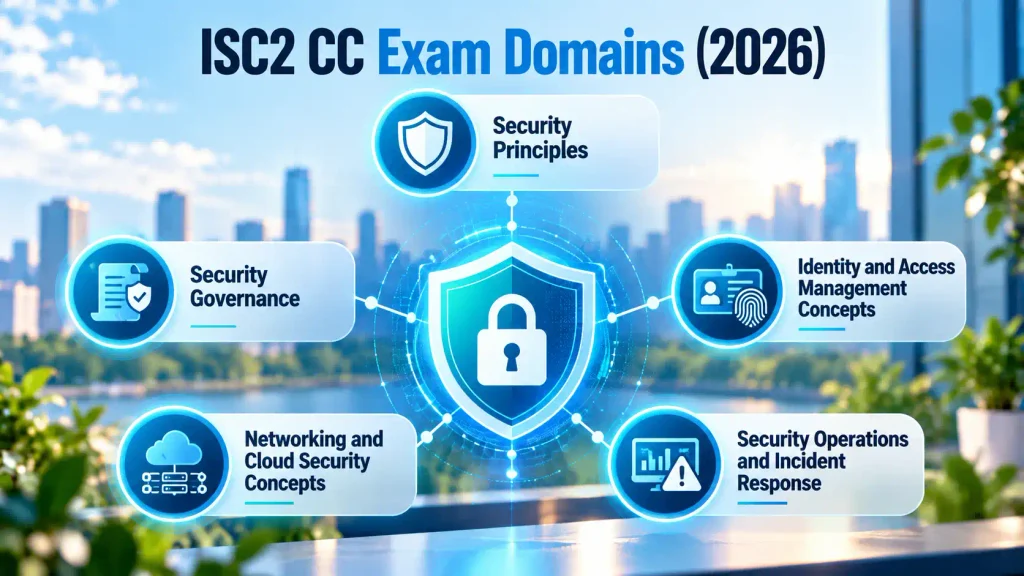
First major content update to the CC exam since the credential launched in August 2022 was made on September 1, 2026. ISC2 revised the domain names and organization to reflect modern security work. Governance now stands as its own dedicated domain. Identity and access management expanded. Cloud security received clearer coverage. The older business continuity grouping was folded into the broader security operations and incident response domain.
How to Prepare for the ISC2 Certified in Cybersecurity Exam
A clear study plan really helps you prepare faster for the ISC2 Certified in Cybersecurity Exam. Rather than trying to cover everything in a few days, work through the syllabus gradually and give yourself enough time to practice.
Step 1: Read the Official Exam Outline
Before buying any preparation material, start with ISC2’s current exam objectives. The official outline of the exam is publicly available on ISC2’s website; you can access it easily and see what’s really gonna be tested. See the topics that you already understand and the entirely new topics to address your weaknesses. Maintain a checklist per domain and keep updating it as you study.
Step 2: Build a Manageable Study Schedule
Divide the material into weekly goals. First week on security principles. Second week on governance and identity management. Following weeks on networking and security operations. Make sure you have extra time to study and practice for the test.
Do not copy another person’s schedule without taking into account his background. A candidate who is familiar with networking skills will go through the cloud technologies much quicker. But a person who does not know anything about clouds will spend more time there.
Step 3: Choose Study Resources That Explain Concepts
See the ISC2-approved outline and select your learning materials such that they do not just define the concepts but explain them in an easily understandable way. Short lessons, flow charts, flash cards, and real-world examples enhance understanding more than just reading can.
You can also explore practice material from CertBoosters when organizing your certification studies. However, regardless of your source, ensure that it provides information about the September 2026 outline and not the old domain groups.
Step 4: Test Your Knowledge With Certified in Cybersecurity Practice Questions
Practice questions have two advantages that readings cannot provide. First, they reveal the domains that you really know from those you believe you know. Secondly, they instill the habit of putting theory into practice through application to realistic situations.
After each session, analyze the wrong answers carefully. Understand the rationale behind the correct answer in the scenario presented. Take note of common errors committed and not just relying on trial and error in guessing the right answer.
Explore ISC2 Cybersecurity Certifications Practice Questions to support your exam review. Practice with these ISC2 Certified in Cybersecurity exam questions and check your readiness before sitting the actual exam.
Step 5: Review and Prepare for Exam Day
When your are revising at the end, pay attention to difficult questions and important connections between ideas. Speak about the topic using your own words. This will be the best way to tell whether you truly understand or not. Because the test is adaptive, learn to make good decisions, knowing you can’t go back.
Confirm testing policies and identification requirements before exam day.
Is ISC2 Certified in Cybersecurity Worth It in 2026?
Yes, ISC2 Certified in Cybersecurity (CC) can be worth pursuing in 2026, especially if you’re a student, career changer, or IT beginner. But how much value does it actually have in the job market? Looking at recent industry research gives us a clearer picture.
According to the U.S. Bureau of Labor Statistics, the number of jobs for information security analysts will increase by 29% from 2024 to 2034, with around 16,000 openings per year. This means that the growth rate is significantly faster compared to other occupations. Even though the statistics represent a broader range of cybersecurity jobs in the U.S., they still show a need for security specialists.
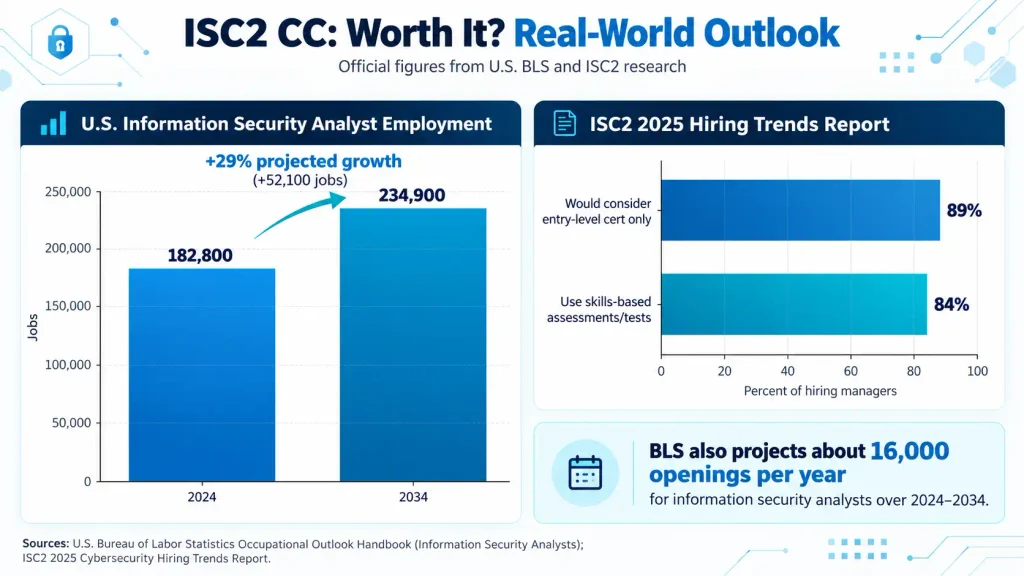
There’s also evidence that employers value entry-level certifications. In its 2025 Cybersecurity Hiring Trends Report, ISC2 surveyed 929 hiring managers across six countries. The research found that 89% would consider candidates who only hold an entry-level cybersecurity certification, compared with 90% who would consider candidates with previous IT experience alone. This suggests that certifications such as CC can help beginners demonstrate foundational knowledge even without professional cybersecurity experience.
In other words, ISC2 Certified in Cybersecurity is of great importance when paired with hands-on training. Acquiring some basic networking skills, experimenting with security software, and developing projects from the very beginning may be beneficial for your future work in IT support and security.
Frequently Asked Questions (FAQ)
Do You Need IT Experience to Earn ISC2 CC?
No formal IT experience is required. Complete beginners can register and sit the exam. Candidates with some exposure to networking or IT support tend to move through the material faster, particularly the Networking and Cloud Security domain. Starting from zero means preparation takes longer. That is not a barrier. It is something to account for when building your study schedule.
What Does ISC2 CC Certification Cost?
A basic fee of $199 applies to the standard CC examination, but local fees and taxes may vary. Once the individual becomes successful in their examinations and fulfills all the requirements, they pay an annual maintenance fee of $50. To maintain their status as a Certified Chartered Accountant, the individual has to earn 45 CPEs within three years.
Can ISC2 CC Help You Start a Cybersecurity Career?
It helps. It is not a guarantee. Employers hiring for junior security analyst roles, IT support positions, and SOC Level 1 roles look at the full picture. Problem-solving ability, communication, and demonstrated technical practice all factor in alongside credentials.
Who Should Consider the ISC2 CC Certification?
Mostly people at the beginning of something—students who want an early credential before graduation. Recent graduates are still figuring out directions. IT support professionals thinking about a move into security. Career changers coming from completely different fields who want a structured entry point.