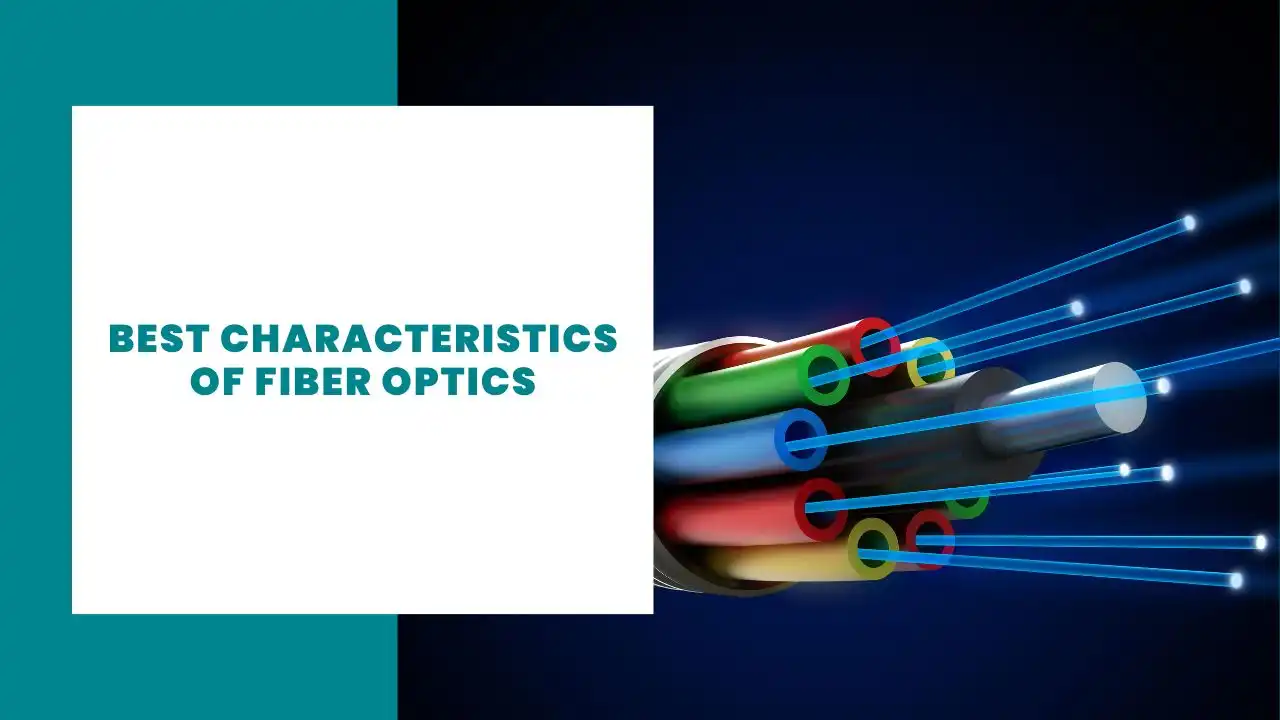
Fiber optics have transformed the way information moves across the world. From global telecommunications to local fiber to the home connections, this technology enables fast, reliable, and secure data transmission. A fiber optic cable uses light instead of electrical signals, allowing data to travel at extremely high speeds over long distances. Understanding the key characteristics of fiber optic systems helps explain why fiber optics provide such a powerful foundation for modern networks.
1. High-Speed Data Transmission
One of the most important characteristics of fiber optic technology is its ability to support high-speed data transfer. Fiber optic cables transmit data using light signals generated by a light source and guided through optical fiber.
Because light travels close to the speed of light, fiber can carry enormous amounts of data per fiber compared to copper cables. This makes fiber networks ideal for high-bandwidth applications, including video streaming, cloud computing, and data centers. High-quality optical transmission also supports advanced techniques such as using wavelength-division multiplexing to transmit multiple signals over a single fiber.
2. Low Attenuation Over Long Distances
Another key characteristic of fiber optics is low attenuation. Attenuation refers to the loss of signal strength along the length of the fiber. Optical fiber experiences far less signal loss than copper cables, allowing data to travel long distances without significant degradation.
This property makes fiber optic cable essential for telecommunications infrastructure and backbone networks. Single-mode fiber is especially effective for long distances because its small core diameter minimizes signal dispersion and maintains optical power over extended transmission paths.
3. Immunity to Electromagnetic Interference
Fiber optic cables are immune to electromagnetic interference. Unlike copper cables, which can pick up noise from nearby electrical equipment, optical fiber uses light rather than electrical signals.
This immunity ensures clean data transmission even in environments with high electromagnetic interference. As a result, fiber systems are widely used in industrial settings, hospitals, and data centers where signal integrity is critical.
4. Efficient Light Guidance Through Core and Cladding
Fiber optics rely on precise optical properties to guide light efficiently. Each fiber consists of a fiber core surrounded by a cladding layer with a lower refractive index. This structure enables total internal reflection, which keeps the light signal confined within the core of the fiber.
As light enters the fiber, it reflects back into the core along the fiber, even when the cable bends. This efficient guidance allows optical signals to travel smoothly from one end of the fiber to the other, supporting reliable data transfer.
5. Support for Different Fiber Types and Applications
Another strength of fiber optics is flexibility in design. There are different types of fiber, including single-mode fiber and multimode fiber. Single-mode fiber supports long-distance transmission, while multi-mode fiber is commonly used for shorter distances, such as within buildings or data centers.
Multimode fiber can include step-index fiber and graded-index fiber, each optimized for specific performance needs. This variety allows network designers to choose the right type of fiber for each application, whether for fiber to the home or enterprise networks.
6. High Data Capacity and Scalability
Fiber optic cables can carry massive amounts of data. The data rate supported by optical fiber far exceeds that of traditional network cable options. By adjusting wavelength and optical transmitter technology, fiber can scale to meet growing demand without replacing the physical infrastructure.
Fiber bundles and fiber connections can be expanded to increase capacity, making fiber technology a future-proof solution. This scalability is why fiber optic cables are essential for modern telecommunications and global internet infrastructure.
7. Durability and Material Advantages
Fiber optics are made from glass fiber or silica fiber, materials known for their durability and stability. Although glass optical fiber may seem fragile, fiber cable designs include protective layers that make them suitable for harsh environments.
Fiber is also lightweight and compact compared to copper cables, allowing more cables to be installed in less space. These unique characteristics reduce installation challenges and support dense deployments in data centers and underground networks.
FAQs About Topic
What is fiber optic technology?
Fiber optic technology uses optical fiber to transmit data as light signals, enabling high-speed and long-distance communication.
How does light stay within a fiber optic cable?
Light stays within the fiber due to total internal reflection between the core and the cladding, which have different refractive indices.
What is the difference between single-mode and multimode fiber?
Single-mode fiber is designed for long-distance transmission, while multimode fiber is used for shorter distances and higher dispersion tolerance.
Why is fiber better than copper cables?
Fiber is immune to electromagnetic interference, supports higher data rates, and allows data to travel longer distances with lower attenuation.
Where are fiber optics commonly used?
Fiber optics are used in telecommunications, data centers, fiber to the home networks, and enterprise communication systems.
Conclusion of 7 Best Characteristics of Fiber Optics
The characteristics of fiber optic technology explain why it has become the backbone of modern communication. From high-speed data transmission and low attenuation to immunity from interference and scalable capacity, fiber optics offer unmatched performance. By understanding these key characteristics, it becomes clear why fiber optic cables are essential for telecommunications, data centers, and future-ready networks worldwide.