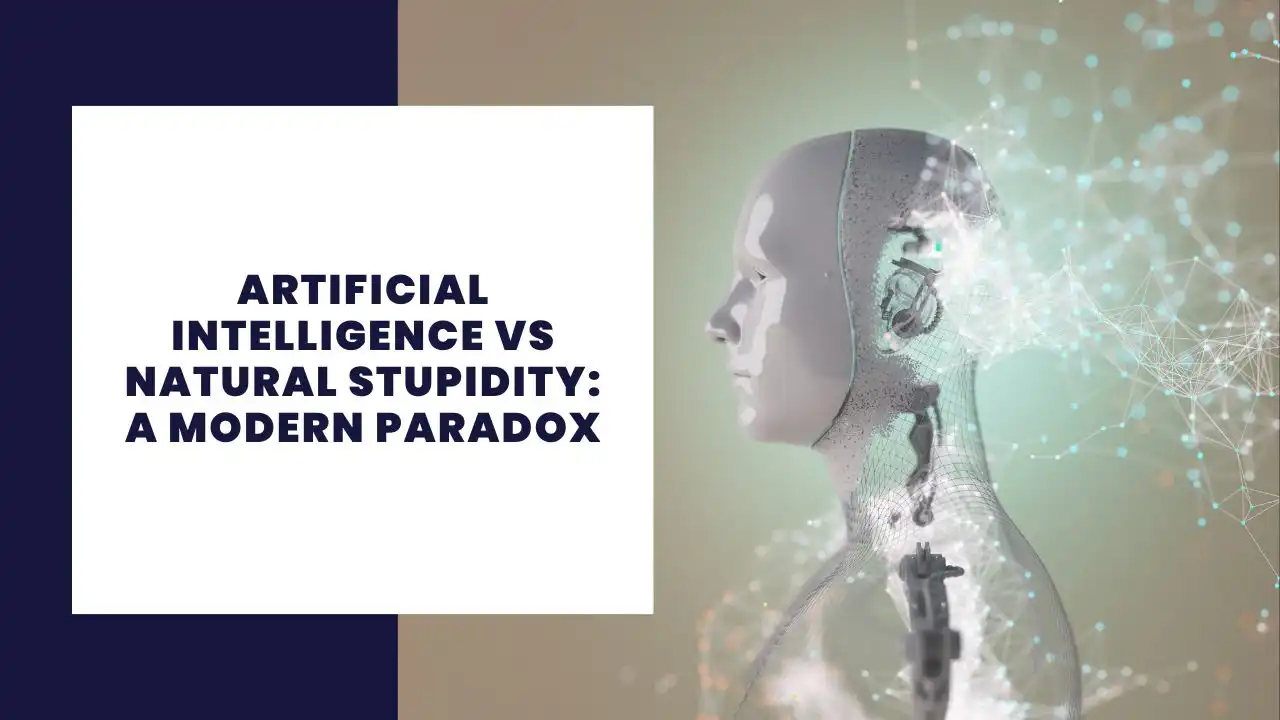
Artificial Intelligence vs Natural Stupidity: A Modern Paradox
The evolution of artificial intelligence has raised profound questions about the future of human decision-making, cognition, and accountability. As tools like ChatGPT, generative AI, and advanced machine learning systems continue to evolve, society is witnessing a sharp contrast between increasingly intelligent algorithms and persistent natural stupidity—a term used to describe the flawed, lazy, or uninformed use of human intelligence in everyday life. The debate around artificial intelligence vs natural stupidity is not only philosophical but also a reflection of our growing reliance on technology, sometimes at the cost of losing touch with critical thinking, intuition, and our natural cognitive abilities.
Written by
- Redaction Team
- Business Technology, Entrepreneurship
Table of Contents
1. What is Artificial Intelligence?
Artificial intelligence (AI) refers to the design and development of machines that can mimic human-like behavior, including problem-solving, decision-making, and inference. AI systems rely on algorithms, data analysis, and computational models to automate tasks that once required direct human intervention.
From chatbots and healthcare diagnostics to autonomous vehicles and recommendation engines, AI is built to enhance accuracy, speed, and precision. With the rise of generative AI, systems are now capable of producing content, answering questions, and simulating human interactions at impressive levels. Yet, as these technologies become more advanced, the risk of assuming they are infallible grows.
2. What Is Natural Stupidity?
Natural stupidity is not simply a lack of intelligence—it is the willful misuse or lack of applying cognitive faculties, logic, or intuition. It’s often the result of laziness, misinformation, or blind reliance on systems without understanding their limitation. While machines can fail due to bad code or flawed algorithms, humans often fail by default through neglect, bias, or refusal to think critically.
Unlike AI, humans are capable of nuance, creativity, and heuristic thinking. But when these capabilities are left unused or misapplied, the results can be equally or even more harmful than flawed machine logic.
3. The Darwin Paradox: Evolve or Automate?
As Darwin emphasized, survival favors adaptability. In the modern era, this adaptability often means using AI to augment and amplify our capabilities. Yet, there’s a growing concern that AI won’t just assist us—it may cause us to evolve into dumber beings by discouraging effort and curiosity.
This paradox suggests that while AI models evolve and improve, natural intelligence might stagnate due to lack of use. The temptation to automate every task can result in humans losing our ability to think independently, make informed judgments, or develop deep expertise.
4. ChatGPT and the Simulation of Intelligence
Tools like ChatGPT represent the cutting edge of AI systems simulating language and dialogue. While these models can complement human interaction and provide rapid responses, they do not possess consciousness, cognition, or genuine intuition.
The danger lies in treating ChatGPT or similar platforms as if they were human-like. This false perception creates a false sense of certainty, reducing the need for verification, reflection, and accountability. As these models improve, maintaining a vigilant perspective becomes essential to avoid falling into the trap of assuming simulated intelligence equals actual wisdom.
5. Human Intelligence and the Rise of Machine Logic
Despite their complexity, AI systems remain programmed tools—built to analyze data, identify patterns, and make predictions. They do not possess mental faculties, intuition, or curiosity.
Human intelligence, however, is dynamic. It adapts based on emotion, ethics, and context. The debate around artificial intelligence vs natural stupidity must therefore include not just comparisons of capabilities but also of accountability, intent, and cognition.
When natural stupidity replaces critical thinking with reliance on automation, it undermines the potential of both AI and humans to function at their best.
6. Limitations of AI and the Importance of Heuristic Thinking
AI is constrained by the data it’s trained on. It can reflect bias, reinforce stereotypes, and misunderstand context. Although AI can outperform humans in data analysis or repetitive tasks, it lacks heuristic abilities—the ability to intuitively make decisions with incomplete information.
Humans, though often flawed, can draw on intuition, life experience, and emotional intelligence to navigate complexity. The danger lies not in building smarter machines, but in creating dumber humans who fail to use these strengths because they overestimate the power of ai systems.
7. Inference, Cognition, and the Neural Gap
The brain remains unmatched in its capacity for inference, adaptive learning, and cognition. While AI mimics neural behavior through artificial networks, it doesn’t achieve human-level awareness or understanding.
Neural networks in machines attempt to replicate the structure of the human brain, but they function through statistical simulation, not experience. There is no self-awareness or reflective capability—only the mechanical process of input and output.
Maintaining this perspective is crucial when deploying AI in contexts such as healthcare, law, or education, where natural stupidity in usage can have significant consequences.
8. Accountability and the Risk of Losing Human Agency
As AI becomes more integrated into professional decision-making, the question of accountability intensifies. Who is to blame when an ai-powered system makes an error—the developer, the user, or the system itself?
If natural stupidity encourages humans to abdicate responsibility in favor of “smart” systems, society risks surrendering human agency. We must remember that machines are programmed, not autonomous moral agents. Maintaining responsibility is key to ensuring AI remains a tool to complement, not replace, human intelligence.
9. Natural Stupidity in the Age of Automation
Stupidity may not be about being uninformed but about refusing to think when thinking is most needed. In the rise of AI, automation offers ease but not necessarily better outcomes.
When people overtrust automation without understanding its limitation, errors multiply. From misdiagnosed patients in healthcare to biased decisions in legal algorithms, the issue is not that AI is replacing humans—it’s that natural stupidity is allowing poor implementation to go unchecked.
This calls for a renewed focus on vigilant human oversight and improved critical thinking across all sectors.
Conclusion
The debate of artificial intelligence vs natural stupidity is not about who is smarter—it’s about how each is used. AI, with its machine learning capabilities and neural networks, represents a powerful tool that can amplify human potential. But without responsible usage, it may instead enable complacency and intellectual decline.
Natural stupidity, marked by a lack of cognitive effort, blind reliance, and erosion of intuition, threatens to dull our mental faculties just as AI reaches its peak utility. The solution is not to fear AI, but to harness it wisely, with a strong sense of accountability, curiosity, and ethical awareness.
True progress lies in learning how to complement human intelligence with machine efficiency—not surrendering one in favor of the other. Only then can we ensure that AI enhances, rather than diminishes, what it means to be human.
More about Business Technology