The launch of a new gadget is no longer limited to a press release, a product photograph, and a few technical specifications. Today, brands introduce smartphones, wireless earbuds, smartwatches, gaming accessories, and smart home devices through carefully planned video campaigns. These videos help audiences understand what makes a product different while creating excitement before it becomes available.
Artificial intelligence is changing how these campaigns are produced. Instead of relying entirely on traditional filming, editing teams, and expensive studio arrangements, gadget companies can now use AI to develop visual concepts, animate product imagery, generate scenes, and prepare multiple versions of promotional content.
This shift is particularly important in an industry where product launches happen frequently and consumer attention is difficult to maintain. A short video needs to communicate a product’s value almost immediately. AI gives marketing teams additional ways to achieve that without making every production a large-scale project.
For smaller brands, independent creators, and marketing teams exploring these techniques, a free ai product video generator online can be one of the tools worth considering. It provides an accessible starting point for turning product images and descriptions into video concepts, demonstrations, and promotional material.
Why Product Launch Videos Matter More Than Ever
Gadget buyers often compare several products before making a purchase. Specifications such as battery capacity, screen resolution, processor speed, connectivity, and durability matter, but they do not always explain how a product will fit into everyday life.
A video can communicate that information more naturally.
For example, a smartphone manufacturer can demonstrate its camera quality through sample footage rather than simply listing the megapixel count. A smartwatch brand can show its fitness tracking features through a short sequence of someone exercising. Similarly, an audio company can present wireless earbuds in a commuting or working environment.
Video also gives brands an opportunity to establish an identity. Lighting, music, camera movement, colour choices, and storytelling all contribute to how viewers perceive a product.
However, producing several polished videos for every launch can be expensive. Traditional production may require equipment, locations, actors, product samples, editing specialists, and multiple rounds of revisions.
AI is helping companies reconsider this process.
How Gadget Brands Are Using AI in Launch Videos
Artificial intelligence is not simply replacing conventional video editing. It is introducing additional ways to plan, produce, and adapt product content.
1. Turning Product Images Into Moving Visuals
One of the most interesting applications is transforming existing product photographs into video scenes.
Gadget companies usually have professional product photography available before a launch. These images may include front-facing views, close-ups, packaging shots, and photographs showing different product colours.
AI-powered tools can use these assets as starting points for animated sequences. A static photograph of a pair of headphones, for instance, can become part of a cinematic presentation featuring gradual camera movement, changing backgrounds, and carefully designed lighting.
This approach is particularly useful when a company wants to develop early promotional concepts without arranging another photography session.
It can also help marketing teams experiment with different creative directions. A product might be presented against a minimalist studio background in one version and a modern lifestyle environment in another.
The important consideration is consistency. AI-generated movement should not change the product’s actual appearance or introduce details that are not present in the real device.
2. Creating Cinematic Product Reveals
Product launches often depend on anticipation. Brands may reveal a small design detail before showing the complete device, encouraging audiences to follow the campaign until the official announcement.
AI can help create these visual sequences.
A launch teaser for a new smartwatch might begin with a close-up of its display, followed by a slowly rotating view of the case and a final shot showing the complete device.
A smartphone teaser could focus on its camera arrangement, screen edges, or distinctive colour before revealing the full design.
AI-generated backgrounds, lighting effects, and transitions can help create an atmosphere around these moments.
The technology is particularly useful during the early creative stage. Marketing teams can test several reveal concepts before choosing one for final production.
3. Demonstrating Technical Features Through Visual Storytelling
Gadget specifications can sometimes be difficult to communicate through text alone.
Consider a smartphone with an advanced cooling system. A conventional advertisement might simply mention improved heat management. A more engaging video could use an animated internal view to explain how heat moves away from important components.
Similarly, a wireless charging feature could be presented through a simple sequence showing how the device connects to its charging accessory.
AI can help develop explanatory scenes, animations, and supporting visuals that make these technical ideas easier to understand.
However, technical accuracy remains essential. Generated animations should be reviewed against actual engineering information. A visually impressive demonstration is not useful if it gives customers an incorrect impression of how the product works.
4. Personalising Videos for Different Audiences
Not every customer buys a gadget for the same reason.
A gaming enthusiast may be interested in processing performance, refresh rates, and cooling. A business professional may care more about productivity, portability, and battery life. A fitness enthusiast considering a smartwatch might prioritise activity tracking, comfort, and durability.
AI makes it easier for marketing teams to experiment with different versions of the same campaign.
The core product footage can remain consistent while the opening message, captions, voice-over, and supporting scenes change according to the intended audience.
For example, a company introducing new wireless earbuds could prepare:
- A productivity-focused video showing calls and working environments.
- A fitness-oriented video highlighting comfort during exercise.
- A travel-focused version featuring commuting and long journeys.
- A general product introduction covering design and everyday convenience.
This approach allows brands to communicate relevant benefits without producing an entirely separate campaign for every audience.
5. Adapting Launch Videos for Different Platforms
A product launch campaign rarely consists of one video.
Brands may need a longer presentation for YouTube, a vertical teaser for short-form platforms, a square promotional clip for social feeds, and a short demonstration for an online product listing.
Each format has different requirements.
A horizontal video can use wider compositions and more detailed demonstrations. Vertical content needs a stronger central subject and a faster introduction. Product listing videos often benefit from simple backgrounds and clear explanations.
AI-assisted editing can help teams create these variations more efficiently.
Instead of rebuilding every version from the beginning, marketers can reuse suitable footage, adjust scene arrangements, generate alternative backgrounds, and adapt captions.
The final versions should still be checked individually. Automatically resizing a video does not guarantee that the product remains properly framed or that important information is visible.
The Role of AI Tools in Modern Gadget Marketing
Different tools support different parts of the creative process. Some focus on generating scenes, while others help with editing, voice production, captions, or visual design.
The most useful approach is to select tools according to the production requirements rather than assuming one platform will handle every task perfectly.
AI Product Video Generators
Product video generators are particularly relevant when a campaign begins with product images, a short description, or an existing creative brief.
They can help turn these materials into demonstrations, advertising concepts, lifestyle scenes, and short launch teasers.
For example, a small electronics company introducing a new Bluetooth speaker might begin with a few product photographs and a description of its main features. An AI-assisted workflow can help develop visual directions showing the speaker on a desk, in a living room, or during an outdoor gathering.
CapCut’s product video creation tool is one option worth exploring in this category. Its approach includes working from product images and descriptions, developing video concepts, and creating different types of product content.
It can be useful during the concept-development stage, particularly for teams that want to explore several creative approaches before investing in a complete production.
AI Video Editing Platforms
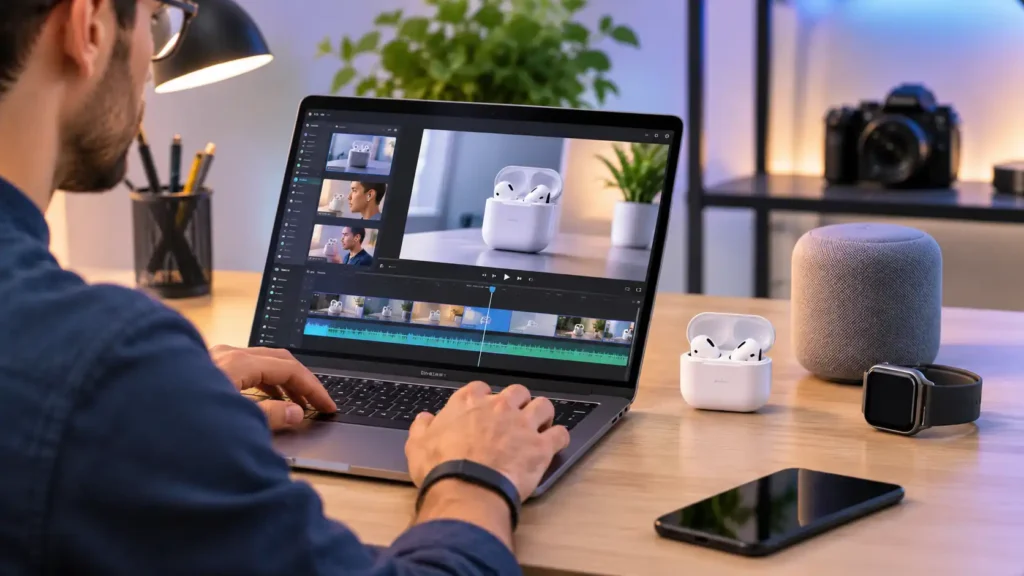
AI-assisted editing platforms help streamline the post-production process.
Depending on the available features, these tools can assist with scene arrangement, captions, transitions, audio adjustments, and resizing.
This is valuable when a brand has already recorded product footage but needs to prepare multiple versions for different channels.
For example, a five-minute product presentation could be edited into several shorter clips. One might focus on the device’s design, another on its most important feature, and a third on its everyday applications.
Human editors still play an important role in maintaining pacing, choosing the strongest footage, and ensuring the final presentation feels coherent.
AI Voice and Caption Tools
Voice-overs and subtitles can make product videos more accessible and easier to understand.
AI-assisted voice production can help marketing teams prepare narration for different campaign versions. Captioning tools can also reduce the time required to create subtitles.
This becomes especially useful when a gadget brand targets international audiences.
A company introducing a new laptop, for example, may need English narration for one market and translated captions for several others. AI can help speed up this adaptation process.
Nevertheless, translated technical terms and product claims should always be checked by someone familiar with the language and subject.
A Practical Example: Launching a New Smartwatch
Imagine a consumer electronics company preparing to introduce a new smartwatch.
The product has three major selling points: improved battery performance, fitness tracking, and a brighter display.
Rather than beginning with an expensive commercial production, the marketing team could use AI to explore the campaign in several stages.
Stage 1: Prepare the creative brief
The team collects product photographs, approved specifications, brand colours, and information about the intended audience.
It then identifies the main message: a smartwatch designed to support everyday activity without making the user constantly think about charging.
Stage 2: Develop the visual concept
The team creates a short storyboard.
The opening shows the watch against a dark background. The next scene introduces the display, followed by a fitness-related sequence. The final scene presents the watch in an everyday