Old systems hold valuable data hostage. You might have a massive on-premise database built in 2004. Today, your sales team needs that exact data on their mobile devices. The old platform cannot talk to modern applications natively. Roughly 60% of digital transformation projects stall out right here. The legacy core simply refuses to communicate with new cloud services.
You have to build a bridge. Developers write modern API wrappers around the ancient code. This exposes the data securely without breaking the old architecture underneath. Let’s look at the top vendors handling heavy legacy integration projects right now.
1. Corsac Technologies
- Hourly Rate: Undisclosed
- Team Size: 50 – 249
- Year Founded: 2007
- Location: United States / Globally
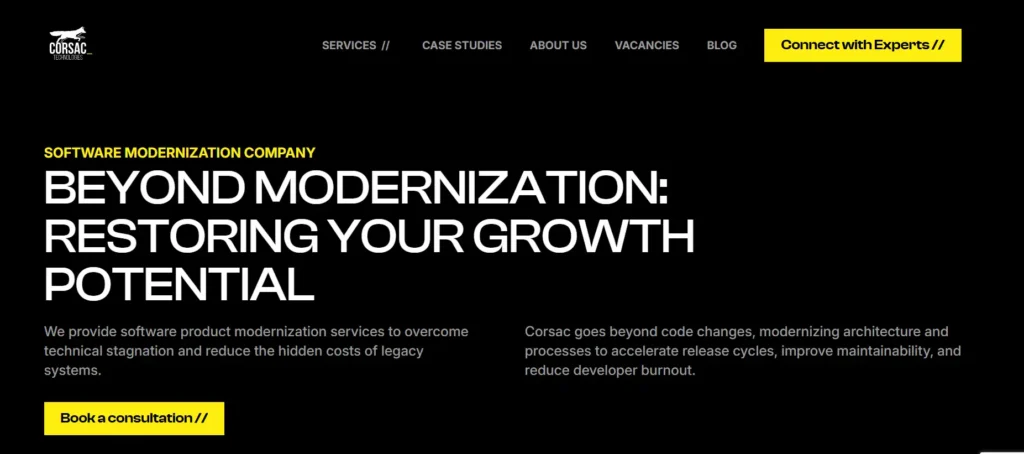
Corsac Technologies builds highly secure communication layers to break enterprise delivery inertia. When outdated systems block new features, they avoid quick fixes. Engineers embed directly into your Git repositories to understand how the original developers stored data. They expose critical endpoints securely, moving brittle logic to .NET Core. Companies help legacy software companies link isolated, aging systems together safely.
2. Reliqsy
- Hourly Rate: Undisclosed
- Team Size: 50 – 100
- Year Founded: 2014
- Location: United States / Worldwide
Reliqsy uses advanced AI to speed up complex integration work. They provide an engineering framework built on a Retrieval-Augmented Generation (RAG) architecture and a Multi-Agent Swarm. This setup reads undocumented code to map hidden logic rules automatically. AI agents then generate modern REST APIs to access that data. Human architects verify the structure. A strict Circuit Breaker acts as a safety net. If a new API gets flooded, it throttles traffic instantly to prevent a database crash.
3. MuleSoft
- Hourly Rate: $100 – $149 / hr
- Team Size: 1,000+
- Year Founded: 2006
- Location: United States
MuleSoft handles massive corporate networks. Retailers use them constantly. A big retail chain might have fifty different inventory systems bought during various mergers. MuleSoft builds a giant enterprise service bus. It connects all those weird, old databases into one central API network. They provide a huge library of pre-built connectors to speed up the process.
4. ScienceSoft
- Hourly Rate: $50 – $99 / hr
- Team Size: 700+
- Year Founded: 1989
- Location: United States
ScienceSoft focuses heavily on custom middleware. Sometimes out-of-the-box integration tools fail completely on highly customized legacy apps. ScienceSoft engineers write specific middleware scripts to force those stubbornly old applications to share data. We see them used a lot in older healthcare networks trying to connect 1990s billing software to brand new patient portals.
5. Itransition
- Hourly Rate: $35 – $49 / hr
- Team Size: 3,000+
- Year Founded: 1998
- Location: United States
Itransition is solid at upgrading communication protocols. Many older logistics platforms rely on heavy, outdated SOAP web services. Itransition converts those rigid setups into lightweight REST APIs. Your modern web developers can then easily pull shipping data into new tracking dashboards. They connect the old warehouse servers directly to new mobile apps.
6. Chetu
- Hourly Rate: Undisclosed
- Team Size: 2,000+
- Year Founded: 2000
- Location: United States
Chetu drops specialized integration teams into your project quickly. They carry deep domain knowledge in hospitality and travel. Airlines still run on incredibly old mainframe booking systems. Chetu builds the API layers that let modern travel websites pull real-time flight data out of those ancient databases securely.
7. EPAM Systems
- Hourly Rate: Undisclosed
- Team Size: 50,000+
- Year Founded: 1993
- Location: United States
EPAM takes on massive regulatory integration. Banks face huge pressure to open their data to third-party apps securely. EPAM builds open-banking APIs over old core banking mainframes. They absorb the massive security risks associated with exposing legacy financial data to the public internet. You hire them when the compliance burden is simply too heavy for your internal team.
What It Comes Down To
Data trapped in a basement server helps nobody. You must connect those old records to modern tools. Every vendor uses different tactics. Some rely on AI to write the API endpoints. Others deploy massive consulting teams to tie applications together. Match the vendor with your specific security needs and corporate timeline. Find the experts in legacy software modernization. That is exactly how an outdated architecture finally stops holding back your business.